Percy, our resident wandering peacock, is pretty certain it’s springtime…one day early, after monsoonal rains related to El Nino last week, 80 degrees yesterday, and a coming bit of rain. It’s always interesting to notice changes in activity & behaviors in nature during the change of seasons.
Seasonal déjà vu
Live each season as it passes; breathe the air, drink the drink, taste the fruit, and resign yourself to the influences of each.
~ Henry David ThoreauThe Autumn counterfeited Spring
With such a flush of flowers,
His fiery-tinctured garlands more
Than mocked the April bowers,
And airs as sweet as airs of June
Brought on the twilight hours.
~Dinah Mulock CraikWhen Summer gathers up her robes of glory, And, Like a dream of beauty, glides away. ~ Sarah Helen Whitman
I really enjoy the transition of one season to another, a bridge between the phases of nature’s inevitable advance. One of the ways I experience it most profoundly is when I am out working in the garden and become seized by a profound awareness of recognition–seasonal déjà vu.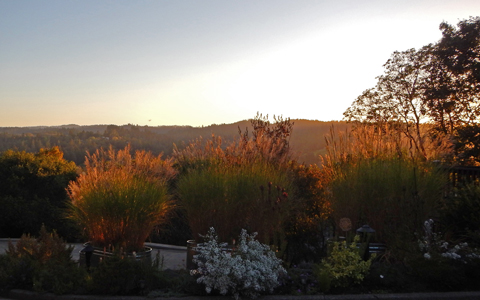
After months of growing comfort, working to be in tune with the unique personality of the current season, it’s invigorating to get a whiff of the approaching season—like a good, old friend when you think you caught a glimpse of them across the street, or a remarkably familiar smell that suddenly forces a sharp, visceral recall into your consciousness. (With my grandmother, it’s certain smells of hearty “old school” cooking or, improbably, Lysol, reminding me of the process of cleaning the garbage room of the apartment building she managed with my grandfather.)
Of course, September 23 is the equinox, so we are not yet in autumn; however, we just had a desperately needed day of rain, so today had that incredible smell of wet dry grass mixed with just slightly moistened parched dirt. The plants & trees at River Myst Haven have been smacked in to a vividness by their first rain in many months that evokes an autumnal “spring awakening.” Correspondingly, the “call of fall” is evoked by various temperature extremes typical for this time of year—nighttime temps will dip to 48° but hit 90 during the day on Saturday. We know the drill: sweatshirt in the morning, t-shirt in the afternoon (and, of course, sun screen)—only more so this year!
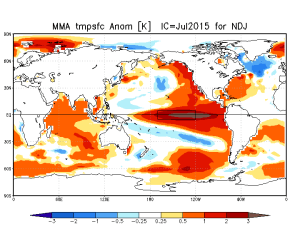
Early model of predicted El Niño. (NOAA CPC)
The unusual weather in California isn’t news any more—our drought has reached exceptional scope and speculation about El Niño is all the rage. It is important to note that this phenomenon of the ocean currents is regular, unpredictable, and erratic in the out comes it produces. This first push of rain hit southern California with up to 2 inches of rain in some areas and heavy flooding in other western states, but left my simple rain gauge at about a half-inch.

Relief agencies.
[You’ve probably heard about the multiple wildfires in the state. Lake County has been hit particularly hard, so I want to post an update on relief needs.]
So, these last several years have been odd but may be the “new normal.” The affect on how things grow is quite noticeable. We experience the change in weather, data points to a change in climate, multiple studies call out the effect of human activity…what I can say for certain is that if these changes remain constant, what we eat when will be affected, as will the cost of food.
The Nature of Hotness
One of the joys of gardening in Sonoma County is growing chiles (or chili. Or chilli.) of many different varieties. The hotness of chiles is rated on the Scoville Scale and is dependent on how much capsaicin is in the fruit. Recently I learned a lesson in the intensity of the Scoville Scale and a bit of humility regarding what I will shove in my mouth without thinking it through.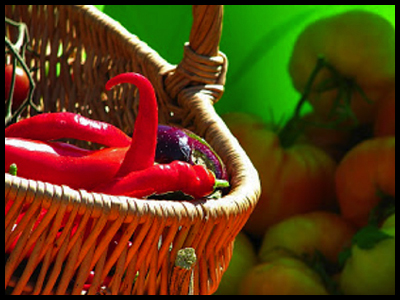
I decided it wise to take a bet with someone to trade and try hot chiles that we each grew. Seems he eats very hot chiles every day for lunch; however, I on the other hand will typically only use them for cooking.
He ate the one I grew like it was candy, so it was my turn. Being small, I ate it in one bite. At first it has a fresh taste and a mild warming sensation. Turns out the chile is referred to as El Diablo, and it lives up to it’s reputation. First I felt a slow, steady burn develop as it I had taken a mouth full of a hot beverage that was uncomfortable but not burning. Ahh, if only it had stopped there. Very quickly, it began to feel like I had taken a mouth full of some chemical that wasn’t supposed to be consumed, and, even more quickly, I began to worry that I would soon be experiencing blistering. Cut to me dashing to the refrigerator… ahhhhh, the calming effect of the fat in several glasses of milk…lesson learned.
Why I care about the New Horizons mission to Pluto
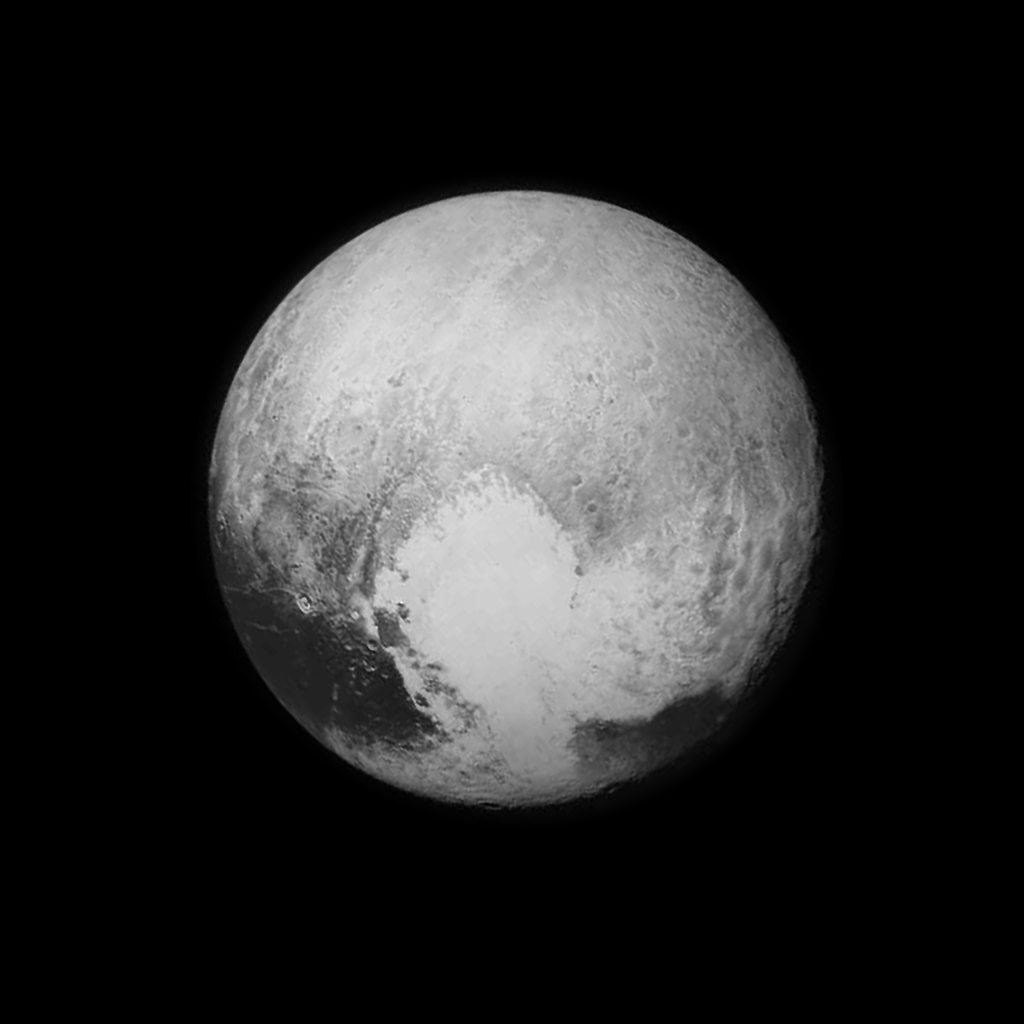
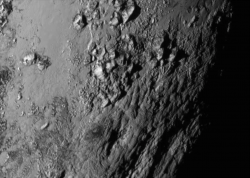
The heart of Pluto got even more interesting in the recent flyby of New Horizons.
About 15 years ago, NASA chose the Applied Physics Laboratory at Johns Hopkins University to build & manage a multifunction machine, using state of the art technology (in 2006), that they could shoot at icy Pluto (formerly known as a planet) about 3 billion miles away. That small spacecraft, against massive odds—the cold of space, solar radiation, impossible-to-know tiny particles that could have ripped it apart, unknown moons recently discovered orbiting Pluto, and the down-grading of Pluto to an “ice dwarf” (wah wah)—prevailed. But why is that important?
The cumulative New Horizons mission cost of only about $700 million, over a decade, is itself remarkable—the U.S. government spends about $700 BILLION a year on each of the following: defense, medical coverage, and social security. (Also for comparison, annual sales at Walmart are about $400 million.)
The 1-month worldwide box office take for Jurassic World is twice the cost of this 10-year mission to reach Pluto and continue to explore the outer reaches of the solar system in which we live. To be clear, people around the world paid $1.4 billion ($600 million in the U.S.) to see a (fun) pretend 2-hour story about a fake, cloned, genetically modified (GMO) dinosaur.
I’m not anti-movie, I’m just pro spending of (relatively) modest sums for pure science.
The craft, about the size of a grand piano, was shot from earth and (more or less) left to barrel through space at 30,000 mph, so fast that a collision with a particle as small as a grain of rice could have debilitated it. After traversing 3 billion miles of the “final frontier” in 9 years, it made contact with the outer reaches of our solar system Tuesday, flying within about 7,000 miles of Pluto. (To be, um, clear, Star Trek’s “Warp 1” is the speed of light, 186,240 mps or 670,464,000 mph.) The mission was a resounding success.
During that time, and especially yesterday, it has collected so much data that it will take nearly 16 months to transmit it all back to earth. Even just that effort is astounding, taking 4.5 hours for data to make the one-way trip. [NASA VIDEO: New Horizons phone home!]
Why? Why does it matter?
To quote President John F. Kennedy’s address at Rice University, Houston, Texas, concerning the nation’s efforts in space exploration (btw, I was 1 month when he gave this speech, to be clear):
There is no strife, no prejudice, no national conflict in outer space as yet. Its hazards are hostile to us all. Its conquest deserves the best of all mankind, and its opportunity for peaceful cooperation many never come again. But why, some say, the moon? Why choose this as our goal? And they may well ask why climb the highest mountain? Why, 35 years ago, fly the Atlantic? Why does Rice play Texas?
We choose to go to the moon. We choose to go to the moon in this decade and do the other things, not because they are easy, but because they are hard, because that goal will serve to organize and measure the best of our energies and skills, because that challenge is one that we are willing to accept, one we are unwilling to postpone, and one which we intend to win, and the others, too.
When even a cursory scan of the news can make one feel that humanity is perhaps caught in a perpetual contortion of confounding, inexplicable, & bewildering behaviors, values, and outcomes—malleable or at least shifting moral & ethics—our astounding achievements of the magnitude of visiting a far-away piece of the beginning of the universe demand a respite and repose.
We are not the sum of the reactive, primitive brain happenings that dominate social media trends.
We are the species that build machines to know more. To understand how we fit into this complex question of creation and existence.
I appreciate that many people who will point to poignant achievements in the arts and humanities to make a similar point—some of whom I adore. It is fantastic to embrace these, as all, authentic achievements that move people.
For me, it’s pure science.
~Timothy
More about the New Horizons Mission Team. It’s the first first with a female MOM, and women make up 25% of the team.
Blue Moon
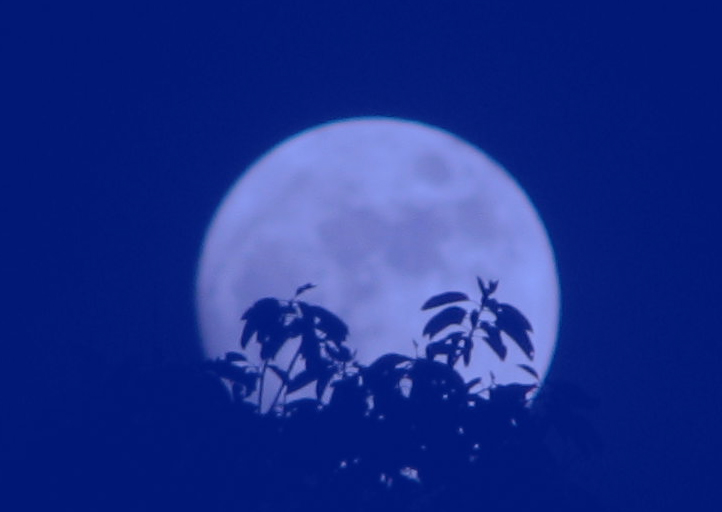
 July Blue Moon: We start and end July with full moons. A rare occurrence, but again, because of the human particulars of our calendar configuration. The Buck or Thunder moon and a Blue Moon.
Midsummer Dreaming
Spring into the solstice, our enduring drought, turning the moon blue
If we shadows have offended,

Think but this, and all is mended,
That you have but slumbered here
While these visions did appear.
—Midsummer’s Night Dream; Puck’s epilogue
The earliest sunrise of the year was Sunday, June 14; yet, the longest day of the year is June 21.
Here we are in late spring, on the verge of summer (preparing to “spring into summer”? too much?), with unseasonably cool weather in the middle of a crippling drought.
Nature—confused or confusing?
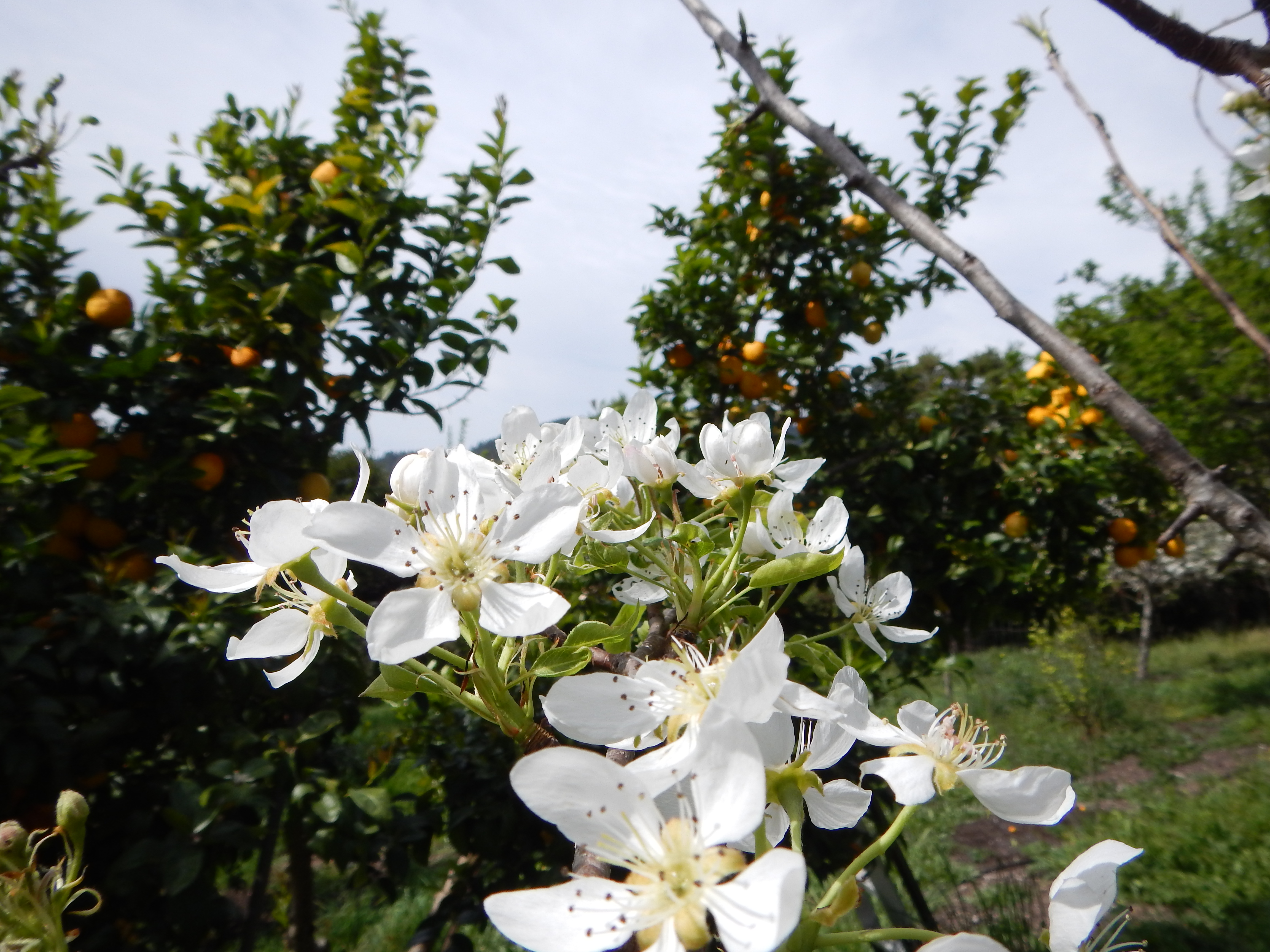 March 20, the first day of spring, seems relegated to the fringes of our calendar of communal obligations: Holiday demands. Shopping frenzies. Awards season. Fund-raising appeals. School activities. The back-and-forth of extracurricular activities.
Stuck between the faux bacchanal of St. Patrick’s Day and the indulgences of spring break, the actual Spring Equinox is oft mentioned but seldom authentically celebrated as a meaningful demarcation of the seasons and transition to a “rebirth” of the natural world.
The summer solstice, the official start of summer on June 21, gets even less respect as its false start is typically signaled by Memorial Day and the end of the school year.
Midsummer is also a Northern European celebration that accompanies the actual solstice (or take place on a day between June 21 and June 25 and the preceding evening. The exact dates vary between different cultures).
[15 Things You Probably Didn’t Know About the Summer Solstice]
This year, the first day of spring was a perfectly nice 70-degree day with a partly to mostly cloudy sky. You certainly recall it was an unseasonably warm and desperately parched winter, so the transition, the Vernal Equinox, seemed even more ceremonial this year, since it had been feeling like spring (or certainly not winter) for weeks. (Ah the guilt of enjoying the great weather while knowing that some predict California may be “out of water” in a year if we don’t get some exceptional precipitation this year.)
So, is nature confused? A very early but very dry start to the spring growing season…an unseasonably cool late spring…a full day of light, drippy precipitation the first week of June. (Let’s not call it rain. The argument would point out how paltry the wetness was relative to the Seattle-like grayness of the day.)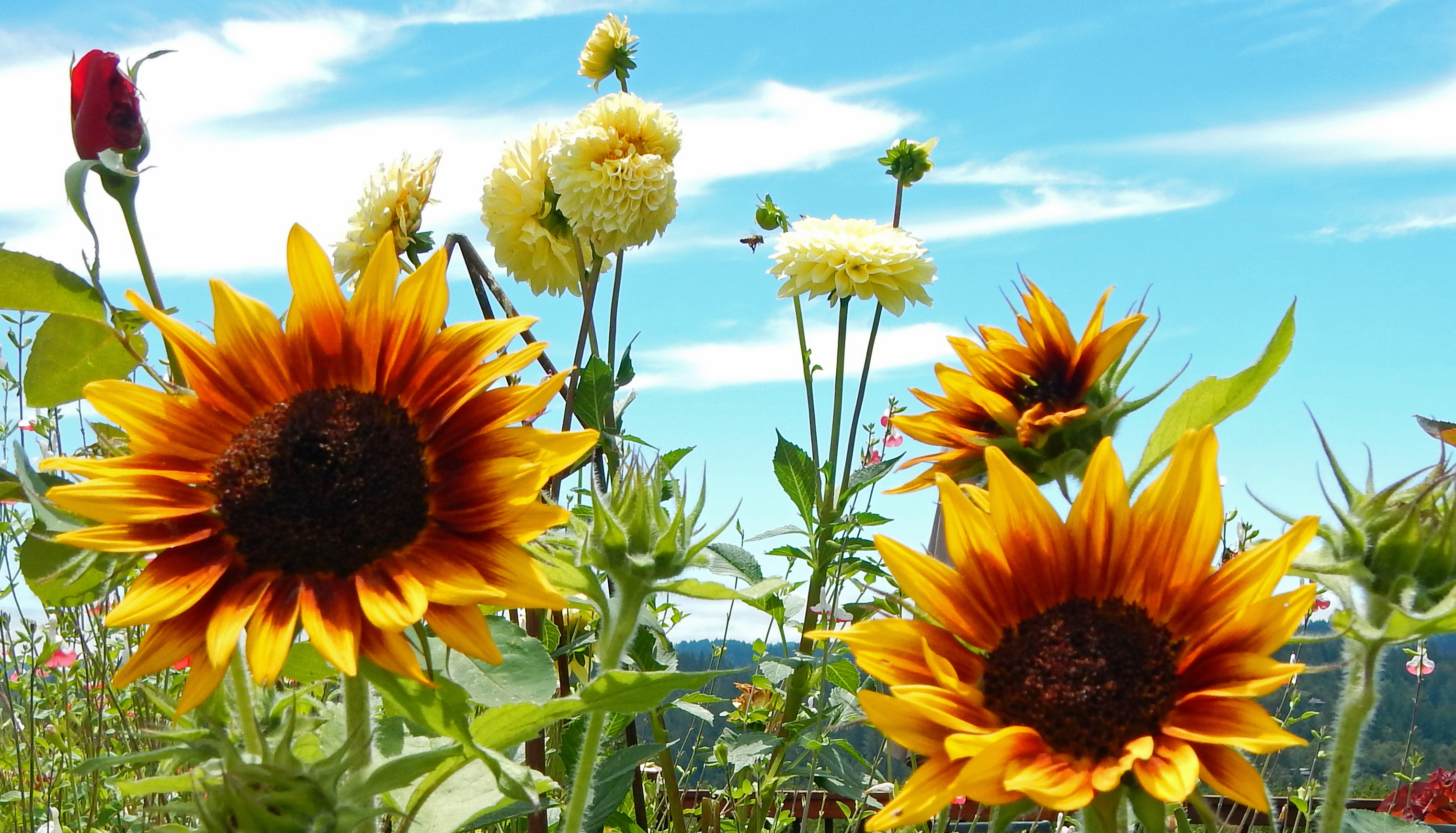
The weather is “unseasonal” and the temperatures are “unusual”; the new growth that occurred in February and March “unreal”; the slowing of development in some of the vineyards due to coolness “unexpected” (sorry, I just got “quote happy”)…but these are relative to human standards. The earth has been working through variations and cycles for, literally, eons.
And, as I look back over my blog posts, I’ve been talking about dry winter and early spring for the last several years. I, in my short half-century have noticed changes. In fact, most incredibly, in the 8 years we have been growing at River Myst Haven, there has been dramatic variation in the seasons. It’s been unmistakable.
[For now, for this post, I am setting aside the issue of how or why the weather and climate are so very atypical—causation and politics.]
I believe that nature finds a way, and, rather than debating the collective phenomena of the physical world, we should find a humility that allows us to better know our place in it. Or, expressed far more eloquently:
“How, then, did we fail to take into account just who or what we were dealing with when we plundered the Earth? It’s probably one more manifestation of the patriarchal mentality, dismissing the Earth as a powerless feminine reality.”
Our gardens are constructions of our preference—a mix of plants chosen to suit our desires with only minimal regard to the influences of local or, dare say, native conditions. With a hubris exhibited only by our species, we cull plants from around the world and place them in our cultivated spaces if we’ve been told they have even the smallest chance of surviving.
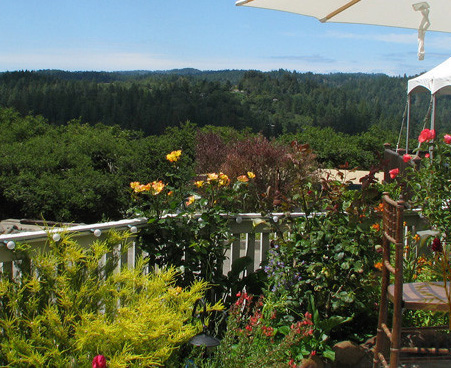 Gardens by human design, horticulture, are often quite engaging and can be monumental achievements in vision, design and execution—they appeal to our very core. We are quite literally cultivating delight.
The “transformative power of the natural world” saves us from ourselves. When we cultivate, it is a controlled natural world, still with the power to transform and delight, but our attempt to make what we most love about nature more accessible. We cultivate and curate, but we’re still on nature’s terms when we do. Our efforts to enhance, enrich, enliven, are always based on timeless, basic rules and laws of nature.
Plants, in their native conditions, are well adapted to survive, even in extreme conditions. The seed itself is a marvelously hardy vehicle to transcend time, place and annual environment to perpetuate the botanical parent.
And yet, we get so very fixated on the ebb and flux of our environment as if it’s the exalted privilege of our species to make and remake the physical world without consequence.
Which Drought?
Water? Water? Everywhere?

Prior to 2011 (when California officially declared drought), surface water made up two-thirds of the state’s supply. Groundwater now makes up a full 75 percent of California’s total supply, up from one-third. (PBS Newshour)
And today, the State Water Resources Control Board issued historic cuts to water rights in the state (LA Times). Long a part of our history, it’s starting to feel perhaps a bit odd that individuals and companies have “rights” to natural resources that are essential to our ability to survive. What the “Rule of 3”? We can “survive” 3 minutes without air, 3 days without water and 3 week without food? In an era of dwindling supplies, should others control rights to massive amounts of these essentials?
Being a California native, I remember clearly the drought of 1976-77. We ran our washing machine “gray water” onto our lawn (the grass smelt so very clean & fresh), and if it was yellow, it mellowed. (In our own home. In a shared restroom, there has to be a public health determination to just flush…) We did it because we cared and wanted to make a difference—there was value in helping help the community.
Perhaps it was the influence of the apocalyptic films of the decade that made us care. (I mean, how many times do you need to watch “Soylent Green,” “Silent Running” or “Logan’s Run.”) However, I recall a much more collective mindset, at least in my teenage mind.
If we breakdown the concept of “drought,” we can have a much more straightforward discussion:
“…four basic approaches to measuring drought: meteorological, hydrological, agricultural, and socioeconomic. The first three approaches deal with ways to measure drought as a physical phenomenon. The last deals with drought in terms of supply and demand, tracking the effects of water shortfall as it ripples through socioeconomic systems.”
Natural resources are integral to our socioeconomic systems, but we simply can’t equate the totality of nature as being resources for economic use. Every material that we desire—from food to clothing to iPads—come form processed natural resources: biological plants as factories processing raw materials into stuff we need and like to eat to buildings we call plants, built factories, processing raw materials into clothing, cars, technology…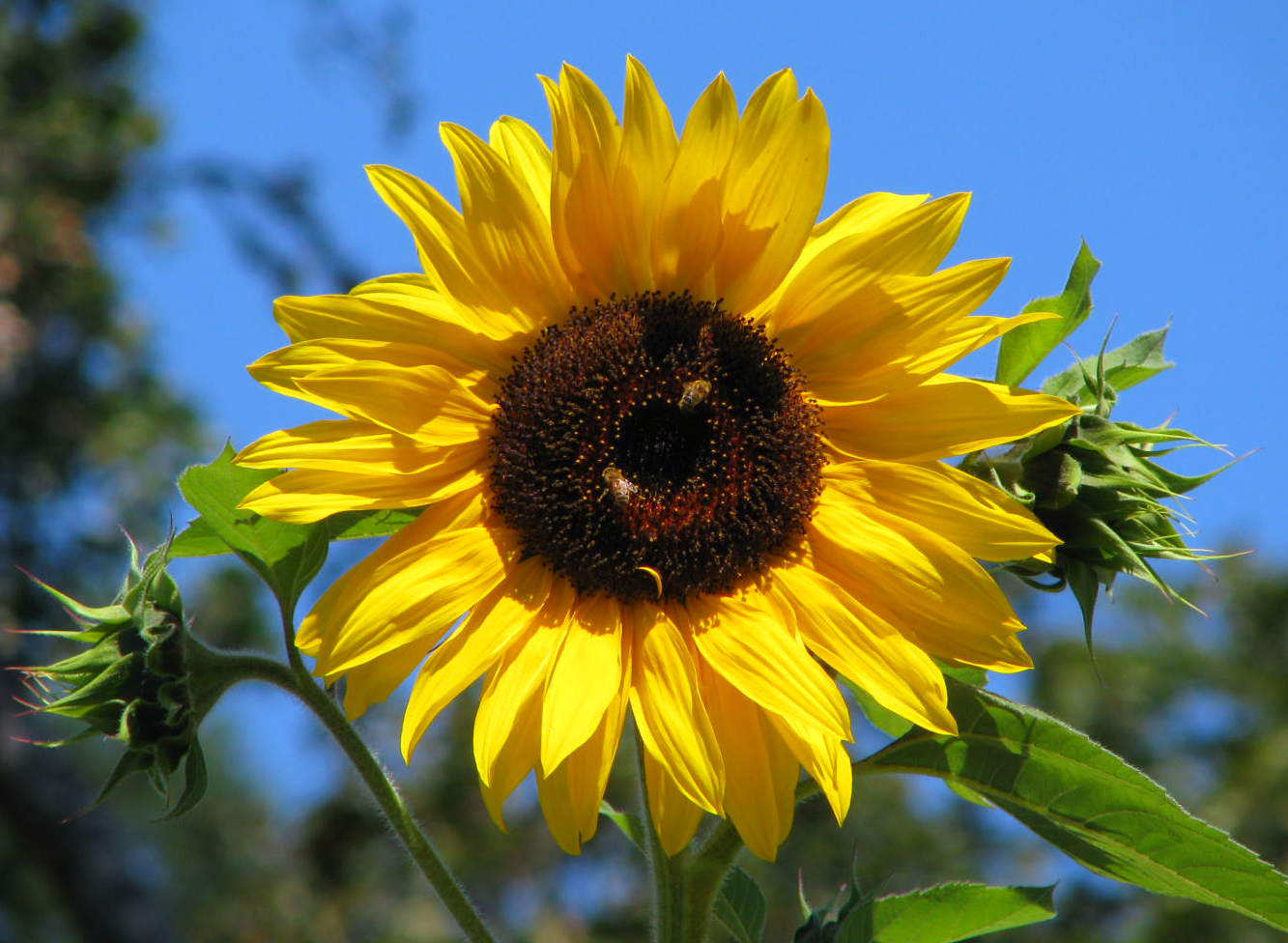
Priorities—the right of the individual to have enough water to survive (3 days) versus the right of the individual to own water for production. Both have rights, but they cannot be equivalent social priorities.
And what of the rights of nature? Ah, the moral and ethical challenge of leaving enough water for the environment—be it helping salmon survive or preventing the ground beneath our communities from collapsing from draining the ground water.
I’ve come to understand that my responsibility as a naturalist isn’t to enforce a specific perspective, objective or opinion on the natural. I seek to serve as a curator, a keeper of a heritage—not of nature itself, but of a connection to and experience of the natural world. I didn’t help create it, and it isn’t mine to hold or possess—I can’t define a specific experience of nature that is mandatory. However, I do believe I have an obligation to inspire wonder and awe in that which surrounds and defines all that we create as a species.
Lavender fills a gap
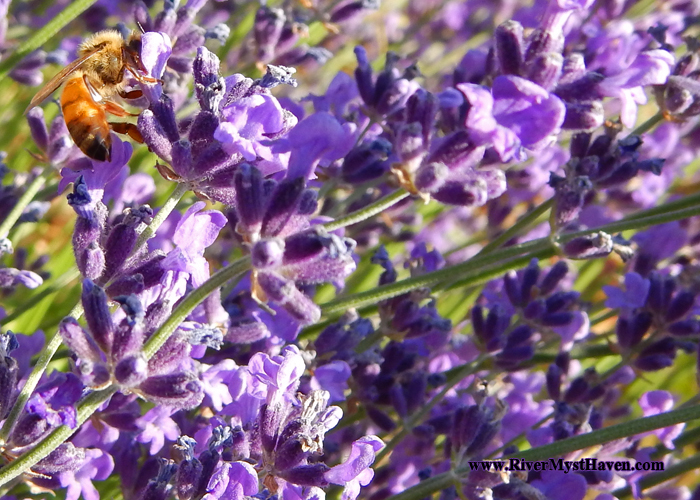
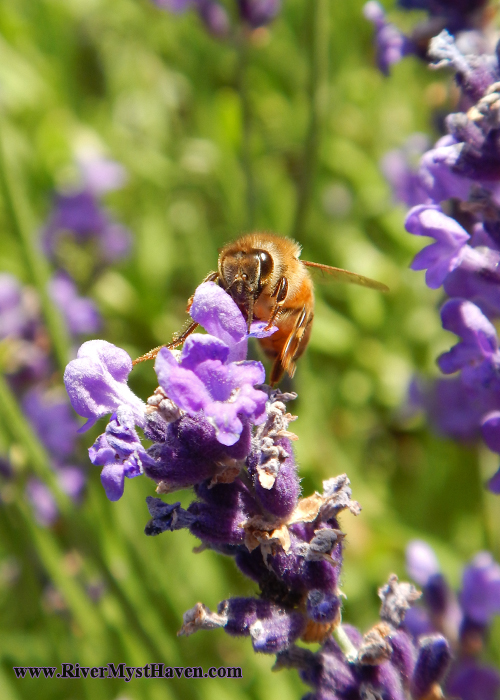 It’s quite exciting to walk past a plant made to sound alive by the urgent buzzing of many bees. Such is the state of the lavender at River Myst Haven.
The hearty, fragrant blooms of the lavender at River Myst Haven help fill a gap in the abundance of blooms during early/mid summer. Also, though mostly subjective (highly argued with little research), some say lavender helps control varroa mites (a scourge in hives).
Honey from the hives of bees who have gathered heavily or predominately from these flowers typically has a lovely floral quality often (but not always) with the distinct scent of the flowers.
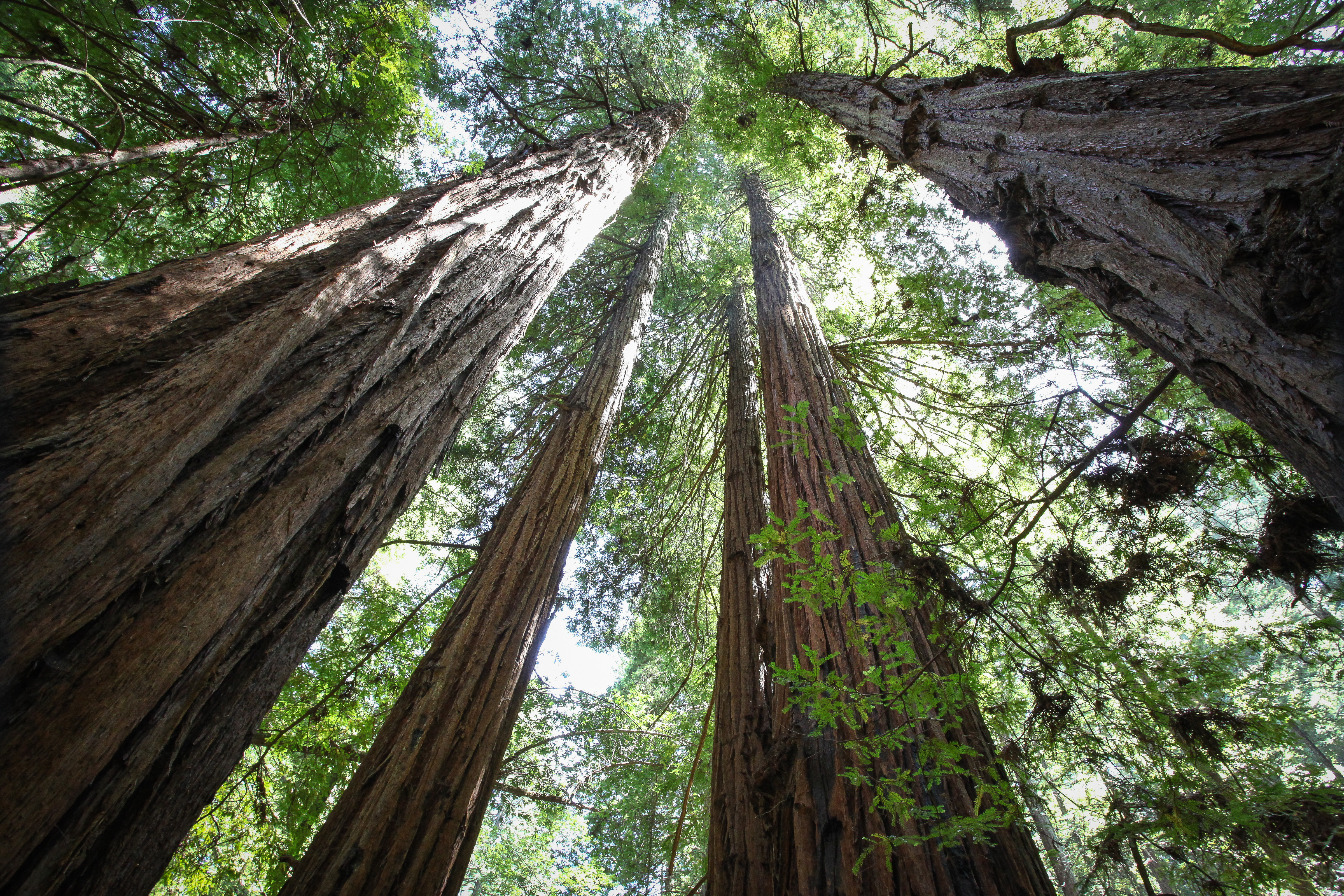 It is really fascinating how news about the environment gets reported. For example, Oxford University just competed a “working paper,” Stranded Carbon Assets and Negative Emissions Technologies, that explored ways to deals with carbon gasses in the atmosphere. A very engaging (if dry) analysis of several/many possible approaches to offsetting or decreasing greenhouse gases in the environment. Essentially they pointed out that something needs to be done to buy some time and mitigate some of the worst possible outcomes to try and stave off very horrendous outcomes for the planet…and us. They propose that trees are the most cost effective approach and suggest we start planting massive numbers of trees. This because a news report about the joy & importance of trees, and their potential role in saving us from ourselves. I read the report as something a bit more ominous–a warning of impending catastrophe and an urging that we are quite threatened by the massive build-up of carbon in the atmosphere. Yes, trees are remarkable, and it’s satisfying to confirm that something so beautiful and simple makes a huge difference in the human experience on the globe…but haven’t we known that for awhile? And isn’t the suggestion to “buy some time” to solve the problem of greenhouse gases a bit less urgent that it should be? Anyway–it IS an interesting study to review…online, to save trees…oh, and Arbor Day is Friday, April 24, 2015.
The Terroir of self
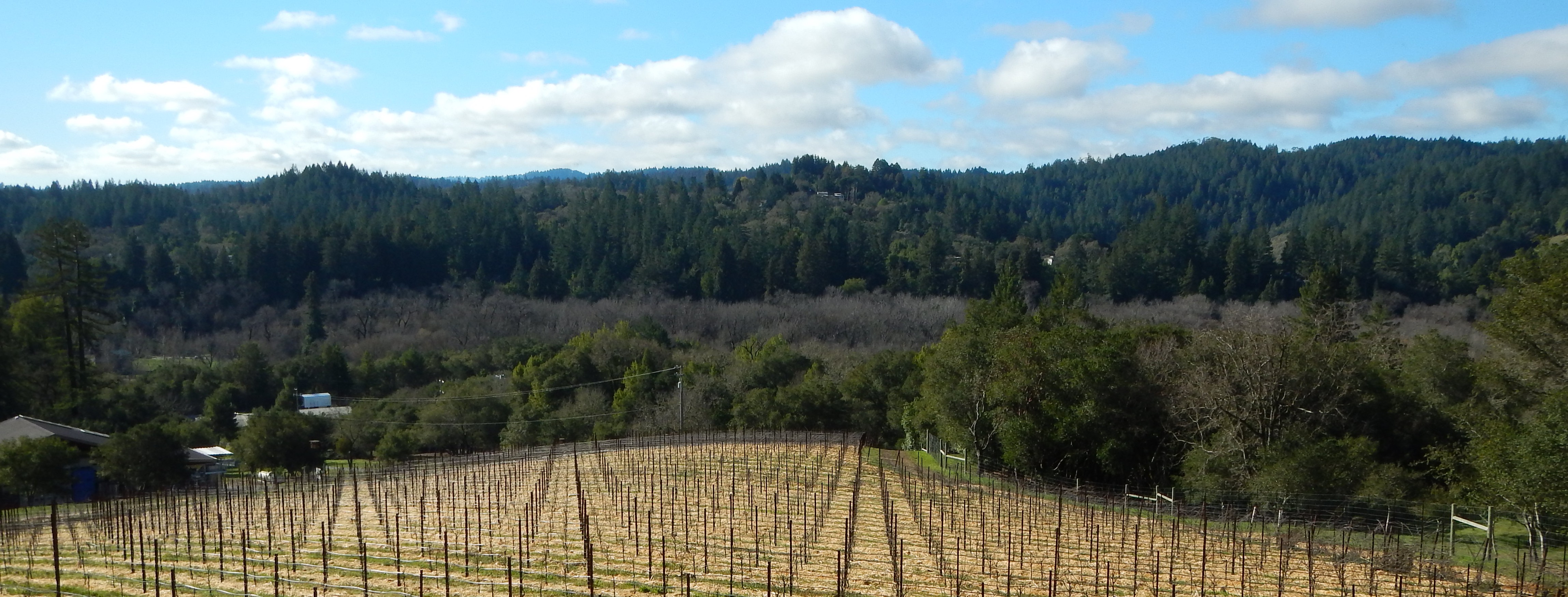
The vineyard at River Myst Haven, our farm in the Russian River Valley.
Terroir (French pronunciation: [ter-wahr or terˈwär] from terre, “land”) is the set of special characteristics that the geography, geology and climate of a certain place, interacting with plant genetics, express in agricultural products such as wine, coffee, chocolate, hops, tomatoes, heritage wheat, and tea.
Terroir can be very loosely translated as “a sense of place,” which is embodied in certain characteristic qualities, the sum of the effects that the local environment has had on the production of the product. Terroir is often italicized in English writing to show that it is a French loanword. ~Wikipedia
“Food, rather than simply being fuel, is the most concrete and intimate connection between ourselves and the earth that exists.” ~Introduction by Norman Wirzba to The Art of the Commonplace, by Wendell Berry
Nature gives us sustenance. It really doesn’t take much science to understand that pretty much all life on earth is fueled by the energy of the sun. (Remember the wonder of photosynthesis.) In fact, it would be monumentally patronizing for me to presume that you don’t grasp this basic truth of life sciences. The basic truths of the other studies of our planet—the multidisciplinary geosciences—are fairly easy to observe.
We can’t help but be connected to nature, in that dependence on air, water & food bind our very sustenance to the natural world. Regardless of how processed one may prefer their food, it has to contain stuff shaped by biology if one is to survive for long.
However, beyond our dependence on the natural world for maintaining our life, this relationship to the planet is essential for our *well* being.
And yet, we’re profoundly and progressively even more disconnected from the natural world. Sadly, it’s to the detriment of the greater social good and ourselves. For the sake of our community and ourselves we need to recommit and more deeply engage a connectedness to the natural world.
Thoreau gave us one early modern articulation of this viewpoint that the good life, and the life that ethically prepares a person for self-government, is necessarily a life lived in contact with nature. “No matter how urban our life, our bodies live by farming.”
Perhaps mentioning Thoreau in only my second post may be off putting, but his writings on the importance of being connected to the land and the environment—as a necessity for social order & good—were made so very long ago that they serve as a keen benchmark of the challenge we have in remembering what sustains us.
Just as terroir determines the characteristics of foods and flavors of a region, the set of special characteristics that the geography, geology and climate of a certain place make us who we are, and, thus, the community what it is.
We are connected to nature and our surrounding environment for sustenance as well as nuance and character. We ignore that to our peril. Well then, seems pretty unambiguous to me.
Nature Matters
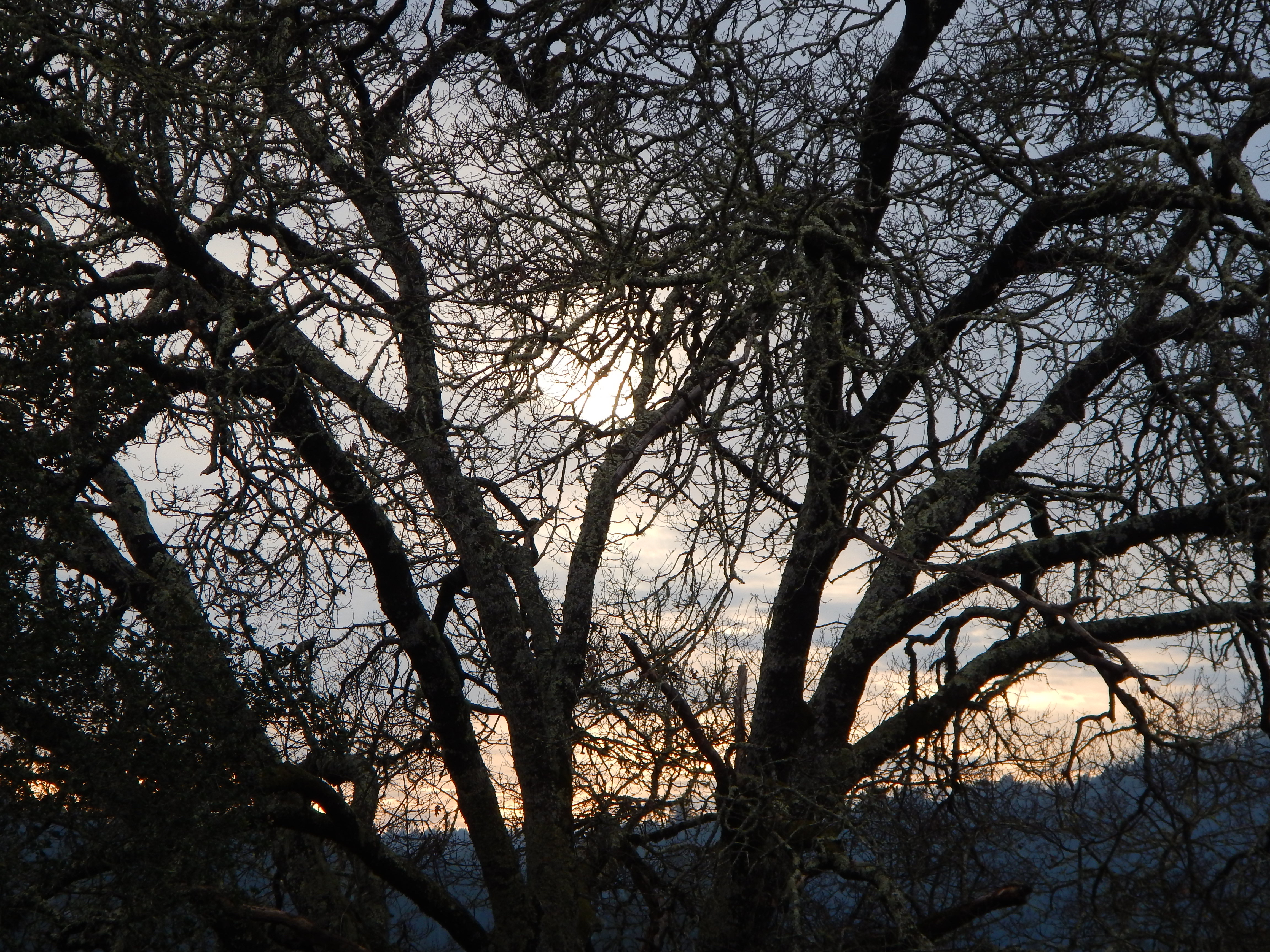
Until we understand what the land is, we are at odds with everything we touch. And to come to that understanding it is necessary, even now, to leave the regions of our conquest—the cleared fields, the towns and cities, the highways—and re-enter the woods. For only there can a man encounter the silence and the darkness of his own absence. Only in this silence and darkness can he recover the sense of the world’s longevity, of its ability to thrive without him, of his inferiority to it and his dependence on it. Perhaps then, having heard that silence and seen that darkness, he will grow humble before the place and begin to take it in—to learn from it what it is. As its sounds come into his hearing, and its lights and colors come into his vision, and its odors come into his nostrils, then he may come into its presence as he never has before, and he will arrive in his place and will want to remain. His life will grow out of the ground like the other lives of the place, and take its place among them. He will be with them—neither ignorant of them, nor indifferent to them, nor against them—and so at last he will grow to be native-born. That is, he must reenter the silence and the darkness, and be born again.

(pg. 27, A Native Hill)―Wendell Berry, The Art of the Commonplace: The Agrarian Essays
It is can be challenging to talk about ecological issues without stumbling into a political schema that might determine the flow, if not conclusion, of the conversation. I certainly don’t want to imply that the politics of saving the environment aren’t important; however, the topic certainly deserves to me more than a determinate of political orientation.
I believe it is possible to have a determined commitment to the land and environment, and a vision is of sustainable, responsible stewardship and experience of the land, flora and fauna, that isn’t a political statement but a philosophy of life.
I’m happy to share that I just became a certified California Naturalist through a program operated by our University of California (UC) Agriculture and Natural Resources department. It was a 6-week blend of reading, independent research, classroom time and a culminating project; it’s actually modeled on California’s Master Gardner program, but in nature.
Most every state in the United States has a Master Naturalist Program, often developed in conjunction with Universities and County Extension offices.
A naturalist might be described, at a basic level, as one who observes, studies, and interprets the natural world. Even more elemental, I believe, is a profound and engaging love of the natural world and its effect on us humans—the “force” so essential in the “Star Wars” mythology. A “a metaphysical, spiritual, binding, omnipotent and ubiquitous power,” as articulated on Wookiepedia. (Yoda, a naturalist he was.)
John Muir, an early California naturalist, once said, “When we try to pick out anything by itself, we find it hitched to everything else in the universe.”
So, there you go. I am happily hitched to everything else in the universe and committed to finding a way to engage my connection as a naturalist. I hope that I will find a way to observe, study, and interpret the natural world in a way that brings some benefit to my community and those connected to it.
[Photo at Austin Creek State Recreation Area. ©2014. Kim Carroll Photography.]
 Natural Musing